How to Make Money With Your Gaming PC in 2025
Your gaming PC can earn $20-50/day while you sleep. Here's exactly how to turn your idle GPU into passive income without crypto mining.
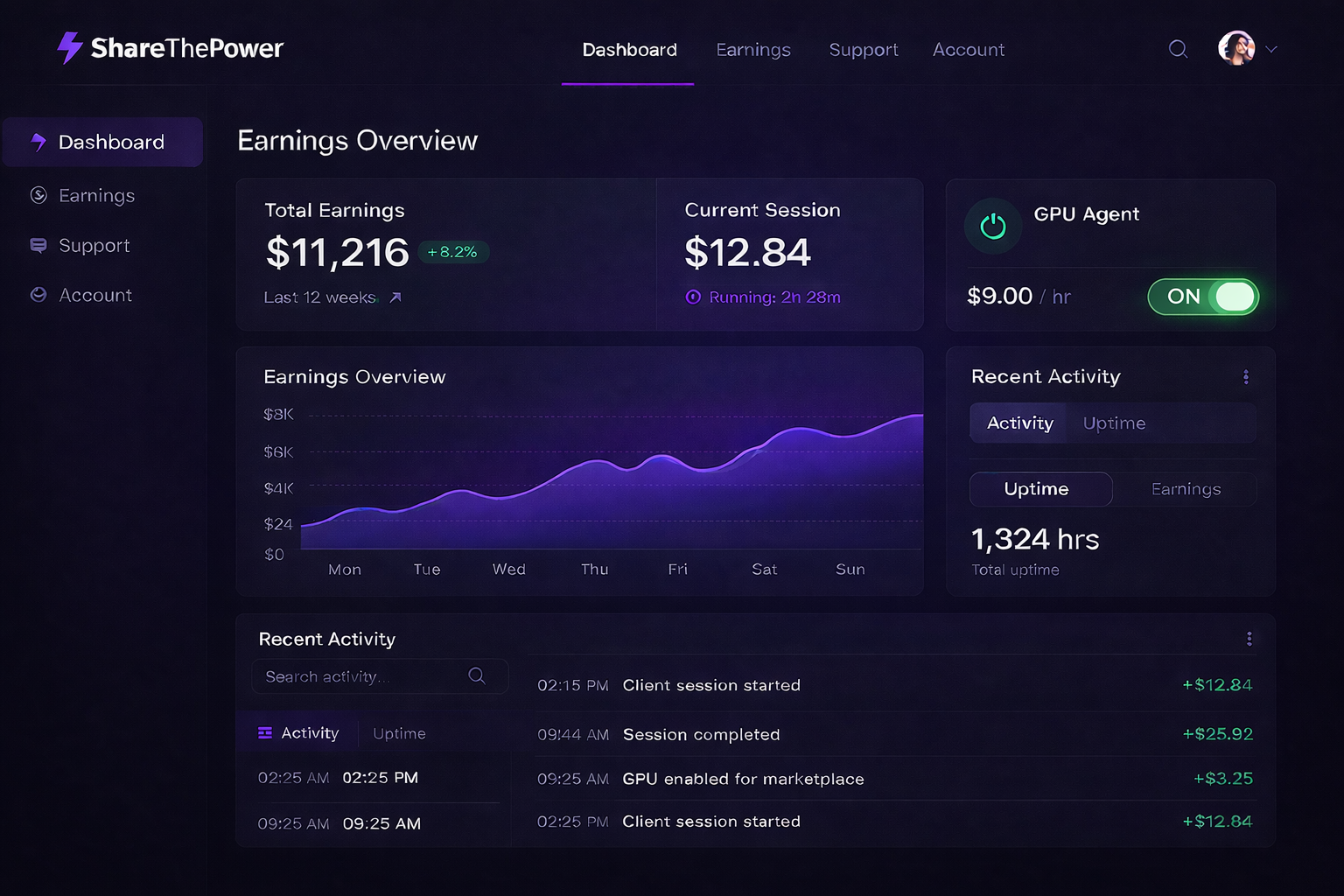
Alright, let's talk about something that's been buzzing in tech circles lately. You've probably seen those Reddit threads or YouTube comments claiming you can make money with your gaming PC while you sleep. And if you're anything like me, your first reaction was probably "yeah, sure, and I've got a bridge to sell you."
But here's the thing. This one's actually real. And no, I'm not talking about crypto mining - that ship has largely sailed for most people with regular gaming hardware.
I'm talking about GPU sharing. And before you click away thinking this is some kind of sponsored fluff piece, stick with me for a few minutes. I'll break down exactly what this is, what kind of money we're actually talking about, and most importantly, whether it's even worth your time.
So what's actually going on here?
You know how AI is basically eating the world right now? Every company and their grandmother is trying to build the next ChatGPT or generate AI art or whatever. Here's the problem they're all running into: there's not enough GPU compute power to go around.
Like, we're talking serious shortages. NVIDIA literally can't manufacture H100s fast enough. Data centers are booked out months in advance. Cloud computing costs are through the roof.
And meanwhile, there are something like 50+ million gaming PCs sitting in bedrooms and home offices around the world, running absolutely nothing for 16 hours a day.
See where this is going?
Companies have figured out that they can tap into all that idle computing power. Your RTX 3060 might not be an enterprise-grade data center GPU, but when you cluster a bunch of them together, you've got something that can actually run AI inference workloads, render 3D scenes, process research data - all the stuff that companies are desperate to pay for.
"Okay but how much are we actually talking?"
This is the question everyone wants answered, so let me just lay out some real numbers.
I'm going to use conservative estimates here because I hate those "make $10,000/month working from home!!!" type articles. Those numbers are usually cherry-picked best-case scenarios that almost nobody actually achieves.
For a typical setup running about 8 hours a day (like overnight while you sleep):
An RTX 3060 - which is probably the most common gaming GPU out there right now - pulls in somewhere between $20-35 per day. Call it $25 on average if you want a single number to work with.
Got something beefier? An RTX 3080 or 4070? You're looking at more like $30-50 range.
And if you're one of those people who dropped $1,600 on an RTX 4090 and are still trying to justify that purchase to yourself, this might actually help. Those things can pull $50-80 per day pretty consistently.
Even if you're on the Mac side, M1 and M2 chips can earn $15-25 daily. Not as much as the NVIDIA cards, but it's still money that would otherwise be zero.
Now, am I telling you this is going to make you rich? No. Let's do the actual math on a typical 3060:
$25/day × 30 days = $750/month.
Minus maybe $15-20 in electricity costs.
So you're looking at around $730/month in actual profit.
Is that quit-your-job money? Obviously not. But it's also not nothing. That's a car payment. That's groceries for a family. That's your Netflix, Spotify, gym membership, and still have a couple hundred left over.
And here's the kicker - you don't have to do anything for it. Set it up once, forget about it, check your PayPal on Thursdays.
If you want to see what your specific card would earn, we've got a calculator on our product page that gives you a pretty accurate estimate based on your hardware and how many hours you'd run it.
"This sounds like that crypto mining stuff"
I get this comparison a lot, and honestly, it's a fair question. But they're actually pretty different.
Crypto mining hammers your GPU at 100% utilization, 24/7. Your fans are screaming, your electricity bill is painful, and you're slowly cooking your graphics card. Plus, you get paid in crypto, which means you then have to figure out exchanges and wallets and all that, and the value of what you earn fluctuates wildly.
GPU sharing is way more chill. You set your own limits - 10%, 20%, or 30% of your GPU power. Most people don't even notice it running at 10-20%. The electricity impact is minimal. You get paid in actual dollars through PayPal or Venmo. And the demand is stable because real companies are paying for actual compute work, not speculative mining.
Also - and this is a big one - mining is barely profitable anymore for most consumer hardware. Between the electricity costs, the competition, and the crypto price swings, a lot of people running mining rigs are actually losing money without realizing it.
GPU sharing actually makes sense economically for the average person with the average gaming PC.
"But wait, isn't this kind of sketchy? Some random app using my computer?"
Okay, real talk. This was my first concern too.
The way these platforms work - at least the legitimate ones - is through sandboxed execution. That's a fancy way of saying the workloads run in an isolated environment that literally cannot access your files, your browser history, your passwords, or anything else on your system.
Think of it like running a virtual machine. The companies using your GPU are processing their AI models or rendering their 3D frames, but they can't see or touch anything else on your computer. They don't want your data anyway - they just want the compute power.
You also control exactly when it runs. Set your hours (overnight, during work, whatever), set your power limit, and you can pause it instantly if you need your full GPU power for gaming or creative work.
That said - and I say this about any software you install - do your research. Not every platform in this space is created equal. Some have sketchy privacy practices, some have terrible payout structures, some are just straight up scams. Look for ones with clear company information, transparent payment histories, and ideally ones that have been reviewed by actual tech journalists or YouTubers you trust.
The practical setup
Assuming you've decided this is worth trying, here's what the actual process looks like:
First, you need to make sure your hardware qualifies. Most platforms require at least an RTX 3050 or equivalent for NVIDIA, or an M1 chip for Mac. Older cards usually don't have enough horsepower to be worth connecting to the network. You'll also need a stable internet connection - doesn't need to be fiber or anything, but if your connection drops constantly, that's going to affect your earnings.
Next, you download whatever app the platform uses. Ours is available here - takes about two minutes to install on Windows or Mac.
Then you configure your settings:
Power level is the big one. At 10%, you can basically forget it's running - you can browse, work, even do light gaming and probably won't notice any impact. At 20%, you might see some performance drop if you're doing GPU-intensive tasks, but normal computer use is fine. At 30%, you're maxing out your earning potential, but I'd save that for when you're asleep or away.
You also set your active hours. I personally run mine from 11 PM to 7 AM (while I'm sleeping) and from 9 AM to 6 PM (while I'm at work). When I'm actually home and might want to game, it's off.
Finally, connect your payment method. Most platforms support PayPal, some support Venmo or direct bank transfer. Payments are typically weekly.
After that? Honestly, you just forget about it. Check your dashboard occasionally if you're curious, collect your payment on Thursday (or whenever), and carry on with your life.
Some things nobody tells you
Let me share a few things I've learned that don't usually make it into the marketing materials.
Your earnings will fluctuate. Some days are better than others depending on demand. If you see $30 one day and $18 the next, that's normal. Look at your weekly or monthly average instead of obsessing over daily numbers.
Location matters a bit. If you're in North America, Australia, or Western Europe, you'll generally see better rates than other regions. This is just supply and demand - there's more enterprise customers wanting compute in certain regions.
Your internet upload speed matters more than download. The workloads need to receive data and send results back, so if your upload is throttled, that can impact what jobs your system can handle.
Summer months might be slightly lower earnings. This is speculation, but it seems like there's less compute demand when a lot of people are on vacation. Winter tends to be stronger.
And finally - don't expect to get rich. I know I've said this already, but it bears repeating. This is passive income in the truest sense. It's not going to replace your job. It's extra money on top of what you're already doing with hardware you already own.
So is this actually worth it?
Let's zoom out and think about this practically.
You've already got a gaming PC. You already pay for electricity (or it's included in your rent). The GPU is sitting there doing nothing most of the time anyway.
The setup takes maybe 10 minutes. The ongoing effort is literally zero.
If you net even $400/month after electricity - which is conservative for most modern gaming cards - that's $4,800 a year. For doing nothing.
Is there a catch? Kind of. You're putting a bit of extra wear on your GPU, though way less than crypto mining would. Your electricity bill goes up slightly, though not by much. And you do have to trust that the platform you're using is legitimate and secure.
For most people with a decent gaming rig, the math works out pretty clearly in favor of trying it.
My suggestion? Set it up, run it for a month, see what you actually earn, and then decide. If it's making you $300+ and you don't notice any impact on your daily computing, that's a pretty easy yes. If it's making $50 and messing with your system, uninstall it and move on.
Low risk, potentially solid reward. Worst case, you wasted an hour of your time.
Getting started
If you want to try this out, grab our app from the download page. It's free to install, we only take a cut of your earnings (so we're incentivized to make you as much money as possible), and you can uninstall anytime if it's not for you.
Run it for a week, see what your actual numbers look like, and go from there.
Questions? Shoot them to support@sharethepower.ai or check out our FAQ page which covers most of the common concerns.
And if you're the skeptical type - good. You should be. Do your research, read reviews, maybe check out our about page to see who we actually are. This isn't a trust-me-bro situation; we're a real company with real people who actually want this to work for you because that's how we succeed too.
Alright, that's it. Hope this was helpful. Go make your gaming PC earn its keep.